




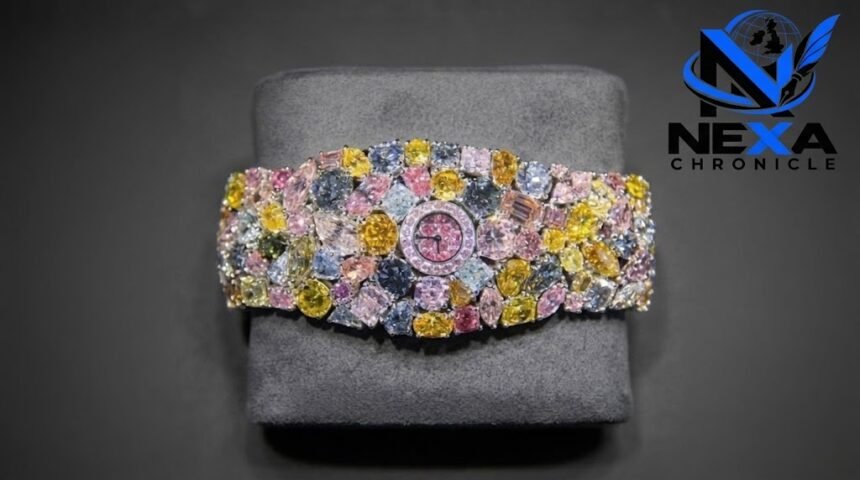
The world of luxury watches is full of beautiful designs, rare materials, and remarkable craftsmanship. However, few creations have attracted as much attention as the Graff Diamonds Hallucination. This extraordinary timepiece combines the beauty of coloured diamonds with the art of fine jewellery, creating a watch that looks more like a piece of modern art than an ordinary accessory.
Unveiled in 2014, the Graff Hallucination became widely known for its reported $55 million valuation and its colourful arrangement of more than 110 carats of rare diamonds. Its design brings together different diamond colours, carefully selected stones, and hours of skilled work. Rather than focusing only on telling the time, the watch celebrates the beauty and rarity of diamonds.
But what makes this creation so special? Who came up with the idea, how were the diamonds selected, and why was the watch valued so highly? Understanding its story reveals how luxury jewellery, creative vision, and expert craftsmanship can come together in one remarkable piece.
What Is the Graff Diamonds Hallucination Watch?
The Graff Diamonds Hallucination is a one-of-a-kind luxury timepiece created by the British jewellery house Graff. It was introduced to the public at Baselworld, a major international watch and jewellery exhibition, in March 2014.
The watch stands out because of its vibrant collection of fancy-coloured diamonds. Instead of using a single colour or a traditional metal bracelet, its design features a mixture of coloured stones arranged across the watch. The result is a striking rainbow-like appearance that makes it instantly recognisable.
According to contemporary reports from jewellery publications, the Hallucination contains more than 110 carats of coloured diamonds. Its original reported valuation was $55 million, making it one of the most talked-about luxury watches ever presented to the public.
Unlike a conventional watch, where the dial, movement, and timekeeping functions often receive the most attention, the Hallucination places jewellery design at the centre of the experience. Its small central dial sits within a much larger composition of precious stones.
This does not mean that it is simply a collection of diamonds placed around a watch. The design required careful planning to bring together stones with different colours, shapes, and sizes while creating a balanced appearance.
The Story Behind the Name Hallucination
The name “Hallucination” reflects the unusual visual effect created by the watch. Its vivid combination of pink, yellow, blue, green, and other coloured diamonds can look almost unreal at first glance.
Many luxury watches are designed around familiar styles, such as a round dial, a metal bracelet, and a restrained colour scheme. The Hallucination takes a different approach. Its colourful surface draws attention away from the traditional shape of a watch and towards the beauty of the diamonds themselves.
The name also suits the experience of seeing so many rare stones arranged in one piece. Each diamond contributes a different shade, creating an overall effect that resembles a colourful mosaic.
The watch’s design is not simply about making something expensive. It demonstrates how precious stones can be arranged to create a distinctive visual statement. That combination of rarity and artistic expression helped the Hallucination gain international attention.
Who Created the Graff Hallucination Watch?
The concept for the Graff Hallucination came from Laurence Graff, the founder and chairman of Graff, a jewellery company known for its work with important diamonds and high-end jewellery.
Graff’s idea was to create a timepiece that expressed his passion for coloured diamonds. Instead of developing a traditional watch and adding a few decorative stones, the concept treated the diamonds as the main feature of the finished design.
The project involved a team of designers, gemologists, and master craftspeople. Each group played an important role in turning the original idea into a finished timepiece.
Designers worked on the overall appearance and arrangement of the stones. Gemologists contributed their knowledge of diamond selection, including colour and quality. Skilled craftspeople then worked on bringing the individual elements together.
According to reports published when the watch was unveiled, the creation required thousands of hours of work. This gives an idea of the time and attention involved in producing such a complex jewellery piece.
The Hallucination reflects Graff’s approach to luxury: using exceptional gemstones to create jewellery that is both technically demanding and visually distinctive.
Graff Diamonds Hallucination Price and Estimated Value
One of the biggest reasons the Graff Hallucination attracted worldwide attention was its reported valuation of $55 million when it was unveiled in 2014.
Jewellery publications, including JCK and The Jewellery Editor, reported this figure at the time of its launch. Graff presented the creation as an exceptionally valuable watch, largely because of the rare coloured diamonds used in its design.
However, it is important to understand what this number means. The $55 million figure was a reported valuation, not evidence that a buyer paid that amount in a completed sale. A public auction result or confirmed transaction would be needed to establish an actual selling price.
The value of an exceptional jewellery piece can depend on several factors, including the quality and rarity of its stones, the design, the workmanship, and its history. The Hallucination brings all these elements together in a single creation.
Why Is the Graff Hallucination So Expensive?
Several factors help explain why the Hallucination received such an extraordinary valuation.
Rare coloured diamonds: Fancy-coloured diamonds are prized for their natural colours and rarity. Finding stones in a variety of attractive shades that work together in one design presents a significant challenge.
High total carat weight: The watch contains more than 110 carats of coloured diamonds, according to reports from its launch. Carat weight measures the weight of the stones, although it does not determine their value on its own.
Specialist craftsmanship: Setting many precious stones into a carefully designed watch requires skill and attention. The stones must be arranged to create a balanced appearance while being securely held in place.
A unique design: The Hallucination was created as a distinctive, individual piece rather than a mass-produced model. Its unusual appearance gives it a separate place in the world of high jewellery.
The Graff name: The reputation of the jewellery house and the involvement of Laurence Graff contribute to the creation’s story and public recognition.
Together, these factors help explain the reported valuation. Nevertheless, a high valuation should not be confused with a guaranteed resale price or proof that the watch will increase in value over time.
Is the Graff Hallucination Available for Purchase?
The Hallucination was presented publicly at Baselworld in 2014. Contemporary reporting discussed its availability at the time, but that does not establish its current ownership or availability.
Because it is an exceptionally rare creation, it should not be treated like an ordinary watch that customers can order from a standard product catalogue. Anyone interested in its present status would need to seek reliable, current information directly from Graff or an authorised representative.
It is also important to distinguish between a historical valuation, an advertised asking price, and a confirmed sale price. These figures describe different things and should not be used interchangeably.
Design and Appearance of the Hallucination Watch
The most distinctive feature of the Hallucination is its colourful arrangement of diamonds. The stones cover much of the visible watch structure, creating a bright, continuous display of different shades.
The combination of colours gives the watch a rainbow-like appearance. Rather than relying on one large centre stone, its design uses many diamonds to create an overall pattern.
This approach requires careful consideration of how the colours interact. A stone that looks attractive on its own may not produce the same effect when placed beside another diamond. The arrangement must work as a complete composition.
Different Colours and Diamond Cuts
Fancy-coloured diamonds occur in a range of colours, including yellow, pink, blue, green, and brown. The colour of an individual diamond depends on factors such as its composition and the conditions under which it formed.
In the Hallucination, different shades create contrast and variety across the watch. This gives the design a livelier appearance than a traditional diamond watch covered mainly in colourless stones.
The cut of a diamond also influences its appearance. Cutting determines the stone’s shape and affects how light interacts with its facets. Different cuts can create different visual effects, so selecting stones for a complex jewellery design involves more than choosing colours alone.
The exact characteristics of every diamond cannot be determined simply by looking at a photograph. Professional grading and detailed information about individual stones are needed to assess their quality.
The Watch Dial and Bracelet
The central dial is relatively small compared with the surrounding diamond-covered structure. This design choice places the emphasis on the colourful stones rather than on the display of the time.
The bracelet also plays a major role in the overall appearance. Instead of acting as a plain support for the watch face, it forms part of the main jewellery design. The stones create a continuous decorative effect across the wrist.
The finished piece combines the practical idea of a wristwatch with the appearance of a high-jewellery bracelet. This is one reason the Hallucination is often discussed as much in jewellery publications as in watchmaking coverage.
How Many Carats Are in the Graff Hallucination?
The Graff Diamonds Hallucination is widely reported to contain more than 110 carats of fancy-coloured diamonds. This figure appeared in coverage published when the watch was introduced in 2014.
A carat is a unit of weight used for gemstones. One carat equals 200 milligrams, or 0.2 grams. The carat figure for a jewellery piece usually refers to the combined weight of its stones when described as total carat weight.
However, carat weight is only one part of understanding a diamond’s value. Two diamonds with the same weight may have very different values because their colours, clarity, cut, and rarity can differ considerably.
In a piece such as the Hallucination, the combination of many stones makes selection particularly important. Each diamond must contribute to the intended design while meeting the standards required for a luxury jewellery creation.
What Are Fancy-Coloured Diamonds?
Fancy-coloured diamonds are diamonds whose noticeable colour goes beyond the usual colour range associated with traditional colourless diamonds. Natural examples can occur in shades such as yellow, pink, blue, green, orange, and brown.
These colours develop through different geological processes and, in some cases, the presence of trace elements or changes in the diamond’s crystal structure. The exact cause varies according to the colour.
Natural fancy-coloured diamonds can be rare, especially when a stone has an attractive and strongly expressed colour. This rarity is one reason certain coloured diamonds can command high prices.
Not all coloured diamonds have the same value. Their market value depends on the specific colour, its intensity and distribution, the stone’s size, clarity, cut, and other characteristics.
The Hallucination’s appeal comes partly from bringing a variety of these stones together in one coordinated design.
Why Diamond Quality Matters
Diamond quality involves several characteristics, and carat weight alone cannot explain a stone’s worth.
- Colour: The hue and strength of a diamond’s colour can have a major influence on its value.
- Cut: The cut affects the stone’s proportions, shape, and interaction with light.
- Clarity: Clarity describes internal characteristics and surface features that may affect a diamond’s appearance.
- Carat weight: This measures the diamond’s weight rather than its physical size alone.
- Rarity: Certain combinations of colour, size, and quality are especially uncommon.
For fancy-coloured diamonds, colour is particularly important. A larger stone is not automatically more valuable than a smaller one if the smaller diamond has a rarer or more desirable colour and superior characteristics.
For this reason, the value of the Hallucination cannot be calculated by multiplying its total carat weight by a single price per carat. The individual stones, their selection, and the finished design all matter.
Craftsmanship and the Creation Process
Creating a watch covered in more than 110 carats of coloured diamonds requires much more than collecting beautiful stones. The diamonds must be selected, organised, set, and combined into a design that works as a complete piece.
When the Hallucination was unveiled, reports described thousands of hours of work by Graff’s designers, gemologists, and master craftspeople. This reflects the complexity of a project in which the individual gemstones and the overall design are closely connected.
Laurence Graff’s Original Vision
The idea behind the Hallucination was to celebrate coloured diamonds in an unusual way. Laurence Graff wanted to create a timepiece that demonstrated the beauty of these stones rather than treating them as small decorative details.
That vision influenced the watch’s appearance. Its colourful surface, compact dial, and diamond-covered bracelet all work towards the same purpose: making the gemstones the centre of attention.
The result differs from a conventional luxury watch designed around a recognisable dial, complicated movement, or established sports-watch style.
The Work Behind the Finished Design
The first challenge is choosing stones that suit the design. Diamonds vary in colour, shape, size, and clarity, so the selection process must consider how each one will look alongside the others.
The next challenge is creating a balanced arrangement. The colours must work together without making the design look disorganised. Stone placement also affects how the finished piece appears from different angles.
Setting the diamonds requires skilled workmanship. Each stone must be held securely, and the structure must support the finished piece while preserving its appearance.
The bracelet adds another practical consideration. A wearable wristwatch must fit around the wrist, so its design cannot be judged by appearance alone. The construction must also allow the piece to be worn appropriately.
Although public reports provide a general picture of the work involved, they do not disclose every technical detail of the Hallucination’s construction. Specific claims about its internal mechanism, exact setting methods, or maintenance requirements should therefore be based on verified technical documentation.
Why Is the Graff Hallucination Watch So Famous?
The Hallucination became famous because it brought together several features that attract attention in the luxury market: an extraordinary reported valuation, a large collection of coloured diamonds, a distinctive design, and a story connected to a recognised jewellery house.
Its launch at Baselworld in 2014 gave it an international platform. Jewellery and watch publications covered the unveiling, introducing the piece to readers who might not normally follow high-jewellery creations.
The $55 million figure helped generate headlines, but the watch’s appearance was equally important. Its vivid colours made it easy to distinguish from more traditional luxury timepieces.
Its Impact on Luxury Jewellery
The Hallucination demonstrates that a luxury watch can function as a piece of jewellery and a form of artistic expression at the same time.
In many traditional watches, precious materials are used to enhance a design whose main focus is timekeeping. In the Hallucination, the diamonds are central to the entire concept. The watch display is present, but the overall visual effect comes from the gemstones.
This approach highlights the creative possibilities of coloured diamonds. Instead of using one stone as a centrepiece, a designer can combine many stones to create a larger pattern.
The watch also shows how a one-of-a-kind object can gain recognition through the combination of materials, craftsmanship, and a clear creative vision.
Hallucination Compared With Traditional Luxury Watches
Traditional luxury watches are often valued for their mechanical movements, accuracy, engineering, brand history, or cultural importance. Some are also highly prized because of limited production and strong collector demand.
The Hallucination follows a different path. Its fame rests primarily on its coloured diamonds, elaborate jewellery design, and reported valuation.
This does not necessarily make one type of watch better than another. They serve different purposes and appeal to different interests.
Someone who enjoys mechanical engineering may prefer a watch with a complicated movement. Someone who appreciates rare gemstones and jewellery design may find the Hallucination more interesting.
Understanding this difference helps explain why the Hallucination receives so much attention despite its small dial.
Read More About: Small Business News: Latest Updates, Market Trends, Funding and Opportunities for Entrepreneurs
Graff Hallucination vs. Other Expensive Watches
The Hallucination is not the only high-value creation from Graff. In 2015, the company introduced another remarkable piece called the Graff Fascination.
According to JCK’s March 2015 reporting, the Fascination was presented with a reported $40 million valuation. It featured approximately 152.96 carats of white diamonds and a 38.13-carat D-flawless pear-shaped diamond that could be detached and worn as a ring.
The two watches illustrate different approaches to high jewellery.
The Hallucination focuses on a colourful collection of fancy-coloured diamonds arranged across a distinctive watch design. The Fascination, by contrast, was designed around white diamonds and a large centre stone that could be worn separately.
Their reported valuations also reflect the claims made when each creation was introduced. They should not be treated as confirmed sale prices or used to establish a current ranking without more recent, reliable evidence.
The comparison highlights how jewellery houses can use the same precious material in very different ways. One creation can focus on colour and visual variety, while another emphasises the size and versatility of a single exceptional diamond.
Ultimately, both pieces show that high-jewellery watchmaking is not limited to traditional watch design. It can also explore the relationship between gemstones, wearable art, and technical craftsmanship.
Frequently Asked Questions
1. What is the Graff Diamonds Hallucination?
The Graff Diamonds Hallucination is a luxury timepiece unveiled in 2014. It features more than 110 carats of colourful diamonds arranged in a distinctive design.
2. How much does the Graff Hallucination cost?
The watch was reported to have a $55 million valuation when it was unveiled in 2014. This figure is not proof of a completed sale at that price.
3. Who created the Graff Hallucination watch?
The concept came from Laurence Graff, founder and chairman of Graff, with a team of designers, gemologists, and master craftspeople helping to create the finished piece.
4. How many carats does the Hallucination contain?
Contemporary reports state that the watch contains more than 110 carats of fancy-coloured diamonds.
5. When was the Graff Hallucination unveiled?
The watch was unveiled at Baselworld in Switzerland in March 2014.
Conclusion
The Graff Diamonds Hallucination is an extraordinary example of what can happen when rare gemstones, creative design, and specialist craftsmanship come together. Its colourful arrangement of more than 110 carats of diamonds makes it very different from an ordinary luxury watch, while its reported $55 million valuation helped establish its place in discussions about high-end jewellery.
The story behind the Hallucination is just as interesting as its appearance. Laurence Graff’s vision was developed into a finished piece through the work of designers, gemologists, and skilled craftspeople, with thousands of hours reportedly devoted to its creation.
Although its famous valuation should not be mistaken for a confirmed sale price, the watch remains a notable example of diamond-led design. It demonstrates that a timepiece can be more than a way to tell the time: it can also be a celebration of rare materials, artistic vision, and the skill required to turn an idea into something exceptional.